Fall,
1999 - Concrete Pipe News Feature Story - "Small
Diameter Concrete Pipe
Proves To Be Big Success in Salt Lake
City"
Small diameter precast reinforced concrete pipe (RCP)
is back as a product of choice in Salt Lake City. Geneva
Pipe seized
an opportunity to showcase the quality and benefits of small
diameter RCP for sanitary sewer applications at a time when
it was being overlooked. Local contractors consistently
selected pipe based on lowest first cost of material,
not long-term performance. This practice changed when a leading
contractor carefully assessed available pipe materials
and technology, and opted for precast concrete pipe.

Geneva Pipe Company, a member of the American Concrete
Pipe Association, used the Rose Creek Sewer project to
drive home
the point that precast concrete pipe is an economical,
hydraulically-efficient, and proven choice, for major
sewerage works. The project
involved installation of 8,800 feet, or 1.7 miles, of
18-inch (Class III) reinforced concrete pipe. Other concrete
products
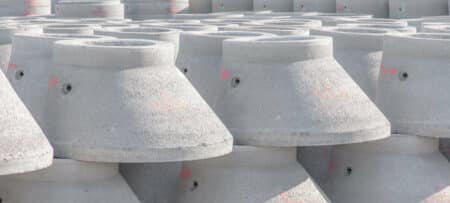
included twelve 60-inch diameter manholes and twenty-two
48-inch diameter manholes. The use of neoprene boots
to join the pipe to manholes makes this installation
a total precast
concrete drainage product solution. Average depth of
the installation was 15.5 feet.
The Southwest section of the Salt Lake Valley is one
of the fastest growing areas of the State of Utah. One
of the challenges
faced by Salt Lake County Sewerage Improvement District
#1 is to keep up with the demands for new infrastructure,
spurred
by the quickly rising population and residential development,
while maintaining services to existing customers. This
is no easy task as the boundaries of the District cover
a wide
service area of trunk lines with varying sizes. These
trunk collection systems convey sewage to a centralized
plant for
treatment.
|
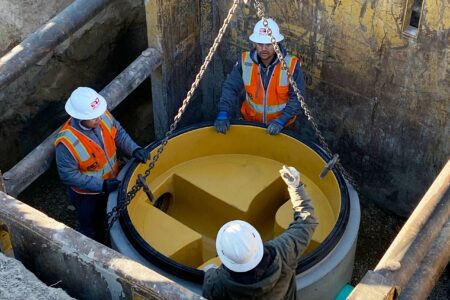
48-inch and 60-inch diameter
manholes with neoprene boots provided a total precast
concrete drainage product
solution. |
HK Contractors of Idaho Falls, Idaho was
the successful low bidder for the trunk sewer project. They
selected
precast concrete pipe over the alternate products
for more reasons
than price. According to Gerry Barker, estimator
for HK, “Reputation
for quality of product, price, and bedding and backfill
were the deciding factors in our decision to use Geneva’s
concrete pipe. With a PVC product, it would have
been more expensive for the bedding material, and
the backfill
would
have been a bigger issue.”
Having secured this level of confidence in the product
from the contractor, Geneva Pipe set out to demonstrate
the reliability
of their precast concrete pipe to both the contractor
and the staff of District #1. Above all,
Geneva wanted this project
to be completed without a hitch, and prove that quality
control measures employed by Geneva Pipe Company and
inherent in
the concrete pipe industry, do pay off.
 |
The skills and experience of the pipe laying crew
were big factors in the successful installation, in
spite of deep, rocky conditions. |
One critical element to their showcase was the measuring
of pipe spigots to ensure tight joint tolerances
and a proper seal using gaskets. A laser scanner that
scans
the
spigot
of the pipe
has been in use for a few years at Geneva Pipe
to ensure that spigots fall within specified tolerances.
The scanner
head
rotates around the
spigot and determines if it falls within the pre-designed
measurements. The pipe is assigned a number and
given
a pass or fail grade. The bells of the pipe are
cast in a
pallet
that remains on the pipe throughout the curing
process thereby enabling the bells to he checked by sight.
Geneva Pipe also air tested every piece of pipe
before shipping it to the job site. Fred Klug,
plant manager
for Geneva Pipe
Company, commented, “Testing every pipe in
this manner may be an expense, but we want to he
sure there
are not
any problems.”
On site, and after installation, runs of pipe were
subjected to low pressure air tests to assure a
sealed system.
This precaution is commonly carried out to avoid
expensive repairs
and liability issues that may arise after the line
has been installed and commissioned. In this case,
where
an 18-inch
line was being installed, access to the system
is limited to pull-through, or crawling equipment,
making repairs
very expensive. The depth of the installation would
have added
greatly to the cost of excavating a portion of
the line.
As the installation progressed toward completion,
air tests were carried out routinely to check pipe
performance.
The
complex installation through deep, rocky conditions
did raise concerns about integrity of the system.
Nevertheless, when
work had ceased, and television cameras drawn through
the entire length, the installation was observed
as being “as
straight as a rifle barrel.”
Much of the success of the installation has to
be attributed to the skills and conscientiousness
of the pipe laying
crew of HK Contractors. There is little doubt that
their installation
techniques contributed to the zero failures assessed
to the project. The experience and skills of the
crew, combined
with excellent weather conditions for pipe laying,
were also instrumental in the fast pace of construction.
On
some days,
well over 400 feet of pipe were placed in the ground
even under deep bury conditions. The project ran
from March to
July 1998. Most of the pipe laying occurred between
April and June.
The successful installation and testing of the
Rose Creek Trunk Sewer achieved the goal set by
Geneva Pipe
Company. The project stands as a testimonial to
contractors of the
value added properties of small diameter precast
concrete pipe. When compared to alternate materials,
reinforced
concrete pipe promises performance and durability,
features often
lost in lowest first cost bids.